

What Is The Combined Percentage Of Hydrogen And Helium In The Sun's Makeup Of Gases?
Saturn'south Atmosphere: All the Manner Down
Saturn is known every bit a gas giant for a reason. The planet lacks a solid surface, and then the transition between the murky temper and the interior is imprecise.
Atmospheric makeup
Saturn is made up predominantly of hydrogen, which it captured in the early on stages of its formation. Most of the remaining composition is helium. Other elements, such equally methane and ammonia, are establish in small doses. Nitrogen and oxygen also mix within the atmosphere.
Although helium makes up most a quarter of the mass of the planet, the atmosphere itself is only nigh seven pct helium. This implies that much of the planet's helium is sinking through the hydrogen.
The distance to Saturn from the sun keeps these gases, and the temperature of the planet, cold. Traces of h2o are present in the atmosphere, but predominantly as ice.
The surface of Saturn is defined by the region where the pressure of the planet reaches i bar, equivalent to the pressure at sea level on Earth.
Climate and weather
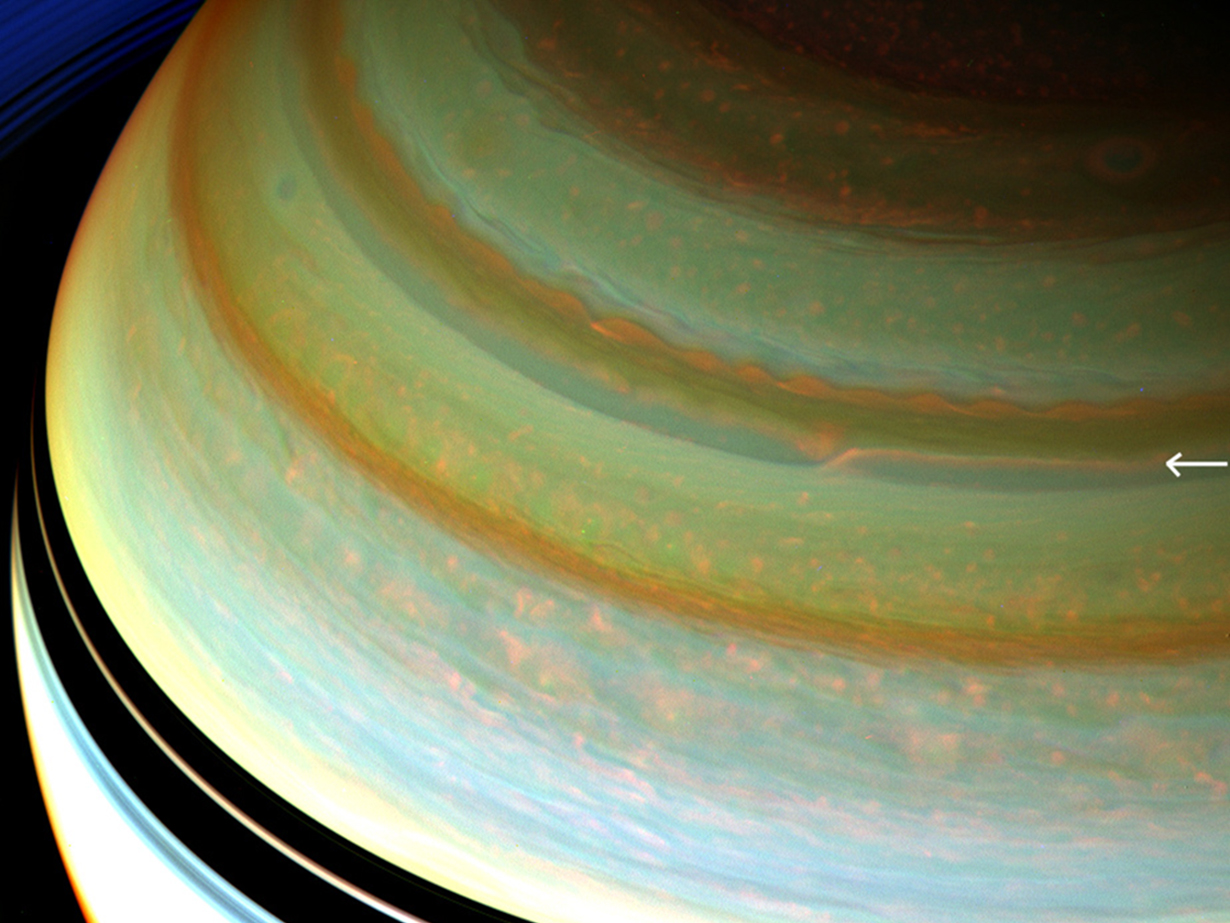
Like Jupiter, Saturn boasts layers of clouds. But the bands of the ringed planet are less stunning than its more brilliantly-striped sibling. Stripes on Saturn are wider, particularly near the equator. The colder bands, where gases are rising, are known as zones, while gas inside the warmer belts falls back toward the planets. Saturn contains more than sulfur than Jupiter, which requite its zones and belts an orange, smog-like cast.
Saturn's temperature and pressure increase from the outside of the planet toward its middle, irresolute the makeup of the clouds. The upper layers of clouds are made up of ammonia ice. Traveling toward the cadre, clouds of water water ice course, with bands of ammonium hydrosulfide ice intermixed. The lower layers of Saturn see higher temperatures and pressures. Water droplets are found here, mixed with ammonia.
Saturn boasts some of the fastest winds in the solar system. NASA'due south Voyager mission measured winds traveling at more than than one,100 mph (1,800 kph) at the planet'south equator, traveling mostly in an easterly direction. Wind speeds die off at higher altitudes.
Cloud patterns on Saturn
Saturn boasts some unique features in its atmosphere. When the Voyager missions traveled to the planet in the early 1980s, information technology imaged a hexagon-shaped cloud formation virtually the due north pole. 20-v years later, infrared images taken past Cassini revealed the storm was still spinning, powered by jet streams that push it to speeds of most 220 mph (100 meters per 2d). At fifteen,000 miles (25,000 km) across, the long-lasting tempest could easily incorporate an World or two.
Other features of Saturn are less long-lived. Gigantic thunderstorms known as Cracking White Spots occur once every Saturn year — that's in one case every three decades on Earth — around the northern hemisphere's summertime solstice.
— Nola Taylor Redd, SPACE.com Contributor
Related:
- How Large is Saturn?
- How Far Away is Saturn?
- What is the Temperature of Saturn?
- What is Saturn Made Of?
- How Was Saturn Formed?
Join our Space Forums to keep talking infinite on the latest missions, night sky and more than! And if yous have a news tip, correction or comment, let us know at: community@space.com.
Source: https://www.space.com/18475-saturn-s-atmosphere-composition-climate-and-clouds.html
Posted by: zuritadind1987.blogspot.com
0 Response to "What Is The Combined Percentage Of Hydrogen And Helium In The Sun's Makeup Of Gases?"
Post a Comment